
With this post, I’m sharing how I completed the assignments and prepared for the final exam of my Master’s “Methods for Policy Analysis” course. Without going into detail about the course content, I’ll also share my impressions of the objective, structure, the assignment process, and the evaluation of the course.
This course introduced research design, research methods, and how to use STATA – a software package for data visualization, statistical analysis, and automated reporting. The course structure was simple, with lectures and tutorials (group sessions of around 13 students). In the tutorials, we practiced data analysis using real-world data (for example, NASA’s data on land-ocean temperature anomalies in the Northern Hemisphere) in STATA.
This time, let me rename myself “Red Queen” because when I write STATA commands, everything turns red due to errors 😂! But wait, things do improve, right? I will show how in the following sections. 😊
The course was assessed by two main assignments: 1) a Research proposal (group work) and 2) a Final exam (individual digital exam). Both weights for 50% of the final grade. For the research proposal, I was teamed up with three outstanding young colleagues, Thomas, Manon, and Chiara, assigned by our tutor. At the start of our group work, we felt completely lost. The topic bit distant from our prior experience and education, our conceptual understanding was weak, and communication did not flow smoothly because we didn’t know each other and this was everyone’s first group task. However, I sensed that we were making an effort to understand the assignment and to move forward together as a team.
The research assignment was that we had to submit a complete and comprehensive research proposal on the theme of “Climate change and global governance for development: evaluating the effectiveness of existing climate-change policies and exploring new governance approaches at local, national, and international levels; identifying barriers and opportunities for implementing climate-friendly policies.” Our research proposal needed to be rational, implementable, and valuable for policy-making and implementation.
We went through a lot of literature to understand the key concepts, how much this topic has already been studied, and to find a suitable spot for our research. The literature review section was the most exhausting for me because of my weak reading skills lol. Then I opened up about how it was a bit difficult for me to read all of it, to include ideas during group discussions, and I said I felt guilty for not really contributing, and I suggested that I do what I am good at, such as structuring information and presenting it in different forms instead of reading tons of materials. Their response was incredible enough, they appreciated me telling them, admitted that they were also a little confused by the task and were struggling to make sense of it. We said we could definitely develop ways of collaborating that would be more inclusive and easier for each member to follow. I felt a bit relieved, and we started communicating better, even our group discussions became productive as well.
After several group discussions and readings, we concluded that the world is not doing well on climate action, and we wanted to understand why countries are failing to do better. Our main research question became: “What factors explain the gap between countries’ actual GHG emission reductions and their Nationally Determined Contribution (NDC) commitments?”
Then we carried out the following steps one by one:
- Developed problem statements to show how serious the situation is and visualized them with data.
- Refined our main research question and developed sub-questions
- Outlined a theoretical and research framework
- Identified key concepts.
- Defined key terms.
- Estimated relationships between variables
- Formulated research hypotheses.
- Developed our research approach (quantitative, qualitative, or mixed).
- Outlined proposed methods and data sources.
- Provided justifications for each choice.
- Discussed the quality and limitations of our proposed research.
As a final result, we produced a shiny research proposal titled “From Commitment to Action: Explaining the NDC Implementation Gap in the Paris Agreement Era.” Isn’t it shiny? (like a glass bottle hahaha!) We really worked well together as a group. A huge thanks again to my wonderful teammates, Thomas, Manon, and Chiara, again.

Now, I’m writing about how I prepared for the final exam. I really needed a good strategy because two exams were scheduled just two days apart, and I couldn’t afford to fail, since I’m a scholarship student (tadaaa!). Luckily, the mock exam was given right after the research proposal submission, so I decided to review the entire course before attempting it.
Unfortunately, I hadn’t taken good notes during the lectures. The only materials I had were the do-files from the STATA tutorials and the book “Essential Statistics, Regression and Econometrics” by Smith. But honestly, that book wasn’t very helpful (oh oh 😬). It’s 380 pages written by a statistician, full of math and statistical terms. So, I had no choice but to go through the tutorial tasks again, identify possible key terms and topics, and predict the types of questions that might appear in the exam.

Now I am finally opening the mock exam. When I compared my predicted questions to those in the mock exam, I was happy to see that I had estimated most of the question types correctly! However, I still wasn’t confident in answering all of them, at least I knew what I needed to know 😄. Continuously, I started working on the mock exam questions, wrote my own answers first, and then asked ChatGPT for feedback. I didn’t ask for direct answers, because our university has strict and clear rules about using generative AI and strong detective tools. We are required to record and report how we use AI in our assignments, also I know people who dropped due to the failures in plagiarism and AI misuse.

My answer: The study time has a significant effect on the final grade (p < 0.001). Without any study time, the predicted grade is about 5.3, and each additional hour of study per week increases the expected grade by approximately 0.12 points. The model explains around 23% of the variation in final grades, indicating that study time is an important but not sole predictor of performance.

Most of the time, I kept my own answers because even though the AI’s answer was almost perfect and written in a more academic style, if I tried to memorize it, I would fail to remember it during the exam, however, it clearly helped me understand the questions.
That mock exam turned out to be a magical support. During the discussion of mock-exam answers in the last lecture, I started to feel much more confident about the actual exam. Also, after the lectures, a few students attended a STATA session to practice more with questions from other mock exam sets (thankfully, the teacher provided more than one set). That was really helpful because when I can understand the answer and explain it to someone else, it strengthens my knowledge. Also, we speak the same language, I mean peer to peer language is different from teacher to student language 😜.
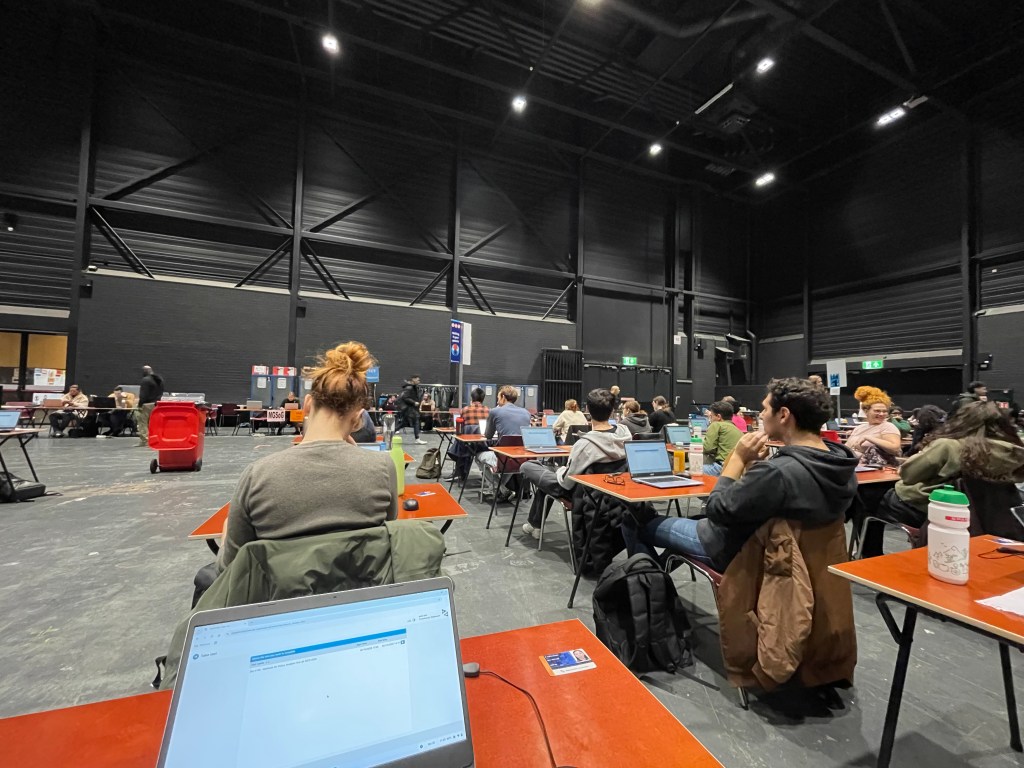
So, would you believe what happened in the real exam? Ahaha. The actual exam questions were mostly reasonable, except for one question. The data-set about a Sub-Saharan African country’s report for SDGoal No.4. I answered most of them, however, I did panic a bit in the exam hall by seeing many people and the actual vision of the digital exam. I also couldn’t manage my time well, so I left 2-3 questions unanswered because I simply had no time for them. There were 22 open questions in 2 hours. Still, I’m confident that I will pass.
Instead of conclusion, the preparation for the first written exam in this Master’s programme gave me the opportunity to review the entire course context, and the course was very helpful for understanding and interpreting the results of data calculations. I hope I am ready for the next core courses, Public Policy Analysis and Advanced Methods for Policy‑Relevant Research!
My next-period goal: from not zero to hero in Stata 😂!

 Doljinsuren
Leave a comment